
Here's What Every Data Analyst Need's to Know About Everything Location Intelligence.
What is Location Intelligence?
- Location intelligence is the process of deriving meaningful insight from geospatial data relationships to solve a particular problem. It involves layering multiple data sets spatially and/or chronologically, for easy reference on a map, and its applications span industries, categories and organizations.
- Location intelligence (LI) refers to using geospatial data to understand how to perform a certain task or solve a specific problem. This is typically done by overlaying geospatial data on a map to study relationships between locations, or how a location’s attributes change over a period of time.
Who uses Location intelligence?
Location intelligence software is mainly built for organizations to collect and compile a significant amount of data, analyze it, filter it, and use it for making business and operational decisions.
- Retail: Selecting sites for brick and mortar stores that are most likely to get repeat customers.
- Insurance: Accurately assessing risk and price policies for properties or people.
- Finance: Making more accurate predictions about which industries or brands will be good investments, and why.
- Healthcare: Measuring accessibility of health services and how geosocial factors affect people’s health (and risks to it).
- Marketing: Understanding who a brand’s main customers are and targeting campaigns to reach them at the places they typically go to.
- Real Estate: Choosing to invest in particular properties that will give good returns when sold to commercial or residential developers.
- Energy: Determining average foot traffic in commercial areas to monitor power use and regulation compliance.
- Telecommunications: Analyzing demand and competition in an area in order to optimally plan a network.
- Government: Planning buildings and services for urban areas based on constituent needs and movement patterns.
What problems does Location intelligence solve?
It helps:
- Organizations to identify where an event has taken place, understand why it is happening, and gain insight into what caused it by adding layers of geographic data.
- In finding optimal locations in retail site selection, managing assets in real time, and maintaining or repairing vital infrastructure.
- Solve business problems and uncover new opportunities.
- Transforms businesses and organizations across a wide range of industries by visualizing, analysing, and ultimately understanding the significance of location information.
- Improve decision making to understand business conditions and plan more effectively.
- Determine the problem so you can track down its cause and correct it permanently.
Why should I use Location intelligence?
Location intelligence has uses across industries, having good location intelligence provides business insights into the demographics and preferences of the people living in an area and improves the overall customer experience.
Turning to location intelligence is a good idea when location plays a vital role in the decision-making process, it offers enterprises the benefits to leverage location information and convert them to actions and insights visualized on an interactive map.
Benefits:
- Retail: the retailer can get even better understanding of potential profitability for a proposed site by overlaying competitor locations.
- Insurance: The spatial analysis provides advantages across the board, from improved risk perception to better capital management to deeper customer relationships.
- Finance: Banks can now quickly define areas where they can optimize profitability, financial efficiency, market gaps, and underserved markets through recognizing how competition, supply and demand, and customer demographics affected their profit and performance.
- Media & Marketing: provided marketers with real-time insight on their intended target and allow these consumer insights to be used for broader business intelligence.
- Real Estate: Can now identify new areas and neighborhood hotspots for potential investment and can also identify and understand risk when making a new investment.
- Telecommunications: Analyzing demand and competition in an area in order to optimally plan a network.
- Public Sector: enable trend spotting and prediction to support market assessment, site selection, risk management, asset tracking and other core government services.
Why now is the right time to start using Location intelligence?
Using location intelligence will help empower your business with holistic planning, prediction and problem solving.
- Enrich traditional data with enhanced contextual information such as a location, including the name of a specific place, or demographics.
- Analyze data more effectively with advanced spatial analysis that drives informed, insight-driven business decisions.
- Visualize key data on maps to make deep analysis and insight-sharing easier and more effective than ever before.
Where can Location intelligence be used?
Location intelligence is a powerful tool for a wide variety of industries. It helps you find the right location with the highest ROI, reduce your risk so you’re profitable and sustainable, and better serve customers with the right information.
Location intelligence helps your businesses identify consumer trends, consumer behavior, and different information about niche markets to deliver better services and products, for better decisions and mitigate the uncertainties in the market.
Below are examples on how Location intelligence technology could be used for different cases/applications:
Media
- ROI-Improve ROI, reduce ad waste and increase footfall.
- ANALYSIS-Perform competitive analysis.
- AUDIENCE-Strategies ad placement and target the right audience.
Telecommunication
- COVERAGE-Assess coverage and plan expansion in specific areas.
- COMPETITIVE EDGE-Gain a competitive edge over other networks and services.
- PROXIMITY-Expand customer base by providing stores in ideal proximity.
Retail
- COMPETITION-Identify competition in a particular neighbourhood.
- ANALYSIS-Site and footfall analysis for new stores and point of sales.
- EXPANSION-Plan expansion in a new city or country.
Public sector
- FACILITIES-Improve public services based on the availability of facilities.
- INFRASTRUCTURE-Optimise and monitor traffic, healthcare, and public infrastructure.
- PLANS-Create crime/disaster response plans by mapping SOS services.
Property
- POI-Map dining, schools, hospital, and facilities around new projects.
- VALUATION-Neighborhood assessment for competition & valuation research.
- LOCATION-Enrich online selling and renting platforms with location precision.
Market research
- SERVICE-Improve service by understanding customers’ patterns and catering to their needs and preferences.
- MARKET-Companies learn about new opportunities, business potential, and areas where it may be under-performing.
- TARGET-Help them target potential customers and entice existing ones.
Insurance
- RISK-Map buildings and structures in disaster-prone zones.
- CONTROL-Insurance companies can widen their customer base, control and minimize risks, accelerate claim procedures, and improve fraud detection with location intelligence data.
- CRIME & THEFT-More in-depth LI data like region-specific crime rates related to car theft, severe weather conditions of the city or state will provide additional information to the insure.
Financial services
- COVERAGE-Assess and improve ATM coverage in a region.
- SEGMENT-Analyze and segment customers according to their location to develop more successful marketing and sales campaigns.
- RETAIN-Financial institutions can also identify and actively retain the most profitable customers as per different areas.
How will Location intelligence benefit you?
Location Intelligence helps businesses identify opportunities and help them plan accordingly, from production to delivery of services and products, with the help of Location intelligence, communication and participation can be streamlined and channeled better and also businesses are now gradually implementing location intelligence as a part of their marketing strategy.
Location analytics and geospatial data can provide accurate information about how good or bad a business is doing. if you combine the location with related retail sales, you can generate certain visualization methods like heat mapping. this will help you identify the moments when certain tangible locations saw an increase or decrease in customer spending.
You can also use real-time market maps to find patterns or correlations between certain trade areas and your stores location. knowing where your customers are, you can use location analytics to improve their experience and deliver what you promised.
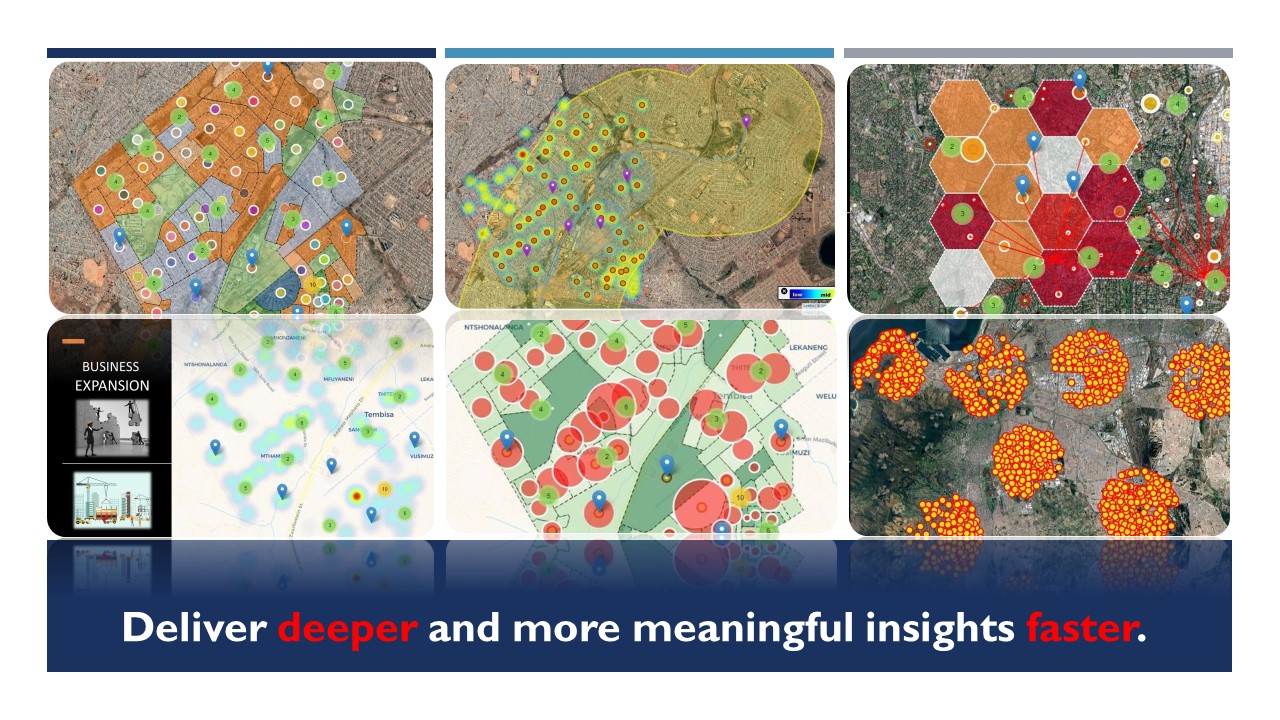
EasyMaps BI allows you to generate real-time maps and visualizations, so that you can filter data and see only what matters interactively.
By the way, did you know that you can Paint Masterpiece Visualization Like A BI Expert Without Ever Using SQL, Scripting or Programming with EasyMaps BI? Yep, it's true.
Go to our website, click on Claim Special now 100% Risk Free Guaranteed, you will then be presented with a form, fill in the form and click the Submit button for your free 30 days 100% Risk Free Guaranteed trial account to be activated.
Thanks
#asymaps #geospatial #spatialAnalysis #locationIntelligence #gis #mapping #businessIntelligence #analytics #visualization